
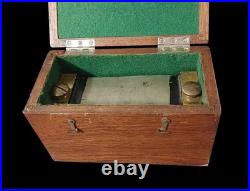
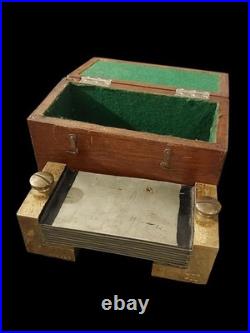






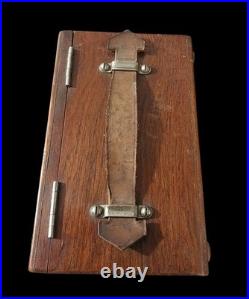





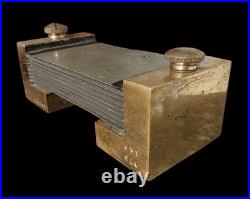






SEE MORE EXCEPTIONAL ITEMS HERE. Most probably made in England or Germany. It represents an era of electrical engineering where laboratory standards were as much a work of art as they were scientific instruments. Measuring 18 cm in length, 8 cm in height, and 8 cm in depth, the device is exceptionally well-preserved and serves as a testament to the “Golden Age” of metrology. Technical Description & Composition. The unit is designed to provide a stable, known resistance for high-voltage measurements, often used in conjunction with a bridge circuit or as a shunt. The Resistive Elements: The heart of the device consists of several parallel, thin plates made of a specialized alloy-most likely Manganin (copper, manganese, and nickel). Manganin was the industry standard for precision resistors at the time because its electrical resistance varies very little with temperature. The Chassis: The plates are held in place by two massive, solid brass terminal blocks. The use of heavy brass ensures low contact resistance and provides the thermal mass necessary to dissipate the heat generated during high-tension measurements. Connection Terminals: Atop each brass block is a large, knurled thumb screw. These were designed to securely clamp heavy-gauge wires or “spade” connectors used in early laboratory environments. Identification Marks: The brass is stamped with several numbers, including a serial number (437344) and specific values (600, 075, 920). These likely refer to its calibrated resistance value or the specific laboratory standards it was tested against. What makes this specific piece a “rare find” for collectors and historians is its state of preservation. Complete & Functional: Unlike many laboratory instruments from this era that were scrapped for their copper or brass, this unit is fully complete. All original screws, plates, and insulating spacers are present. More importantly, it remains in working condition, capable of being used in a modern laboratory context to demonstrate historical measurement techniques. Original Wooden Case: The resistor is housed in its original mahogany or teak wood carrying case. The case features a leather handle with decorative arrow-shaped ends and brass hinges. The interior is lined with vibrant green protective felt, which has protected the brass from excessive oxidation and the plates from physical deformation for over a century. In the early 1900s, as electrical grids were being established, the need for precise standards was critical. A resistor like this would have been used by power companies, universities, or telegraphy firms to calibrate their voltmeters. Its “open-air” plate design was a deliberate engineering choice to allow air to circulate between the plates, preventing the resistance from “drifting” as it warmed up. THANKS FOR YOUR VISIT.